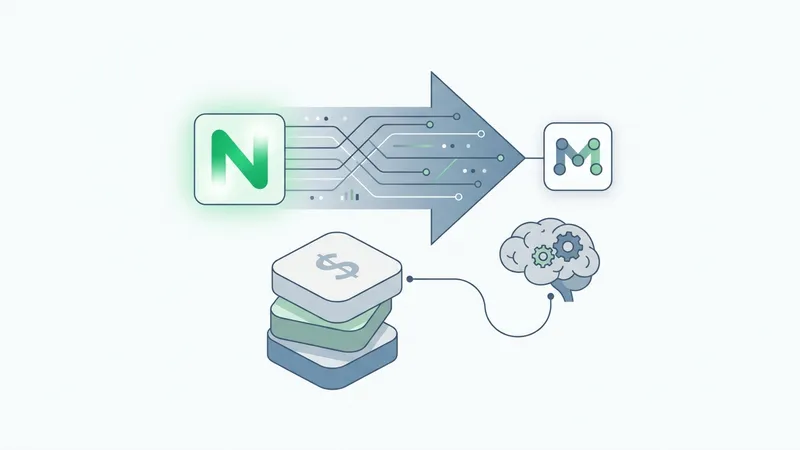
During autoregressive decoding, large output embedding matrices pose a severe memory bandwidth bottleneck, especially for compact LLMs equipped with expansive multilingual vocabularies. To address this efficiency hurdle, a novel study accepted at the ICML 2026 AdaptFM Workshop proposes reformulating the traditional output projection and Top-k token selection as a Maximum Inner Product Search (#MIPS) over token embeddings.
The key innovation lies in replacing the dense vocabulary projection with a hierarchical navigable small world (HNSW)-based vector index. This redesigned output head retrieves only a tiny candidate set of high-scoring tokens and integrates into existing decoding pipelines by scattering these retrieved logits into a sparse full-vocabulary tensor, eliminating the need for massive matrix multiplication.
The researchers evaluated this method on CPU inference using state-of-the-art compact models, including Gemma 3, Llama 3.2, and Qwen 3. The results show a massive acceleration in output projections, raising the batch-size-one decoding throughput of Gemma 3 270M by up to 82%. Crucially, evaluation on AlpacaEval confirmed that this speedup comes with virtually no degradation in generation quality.
[AgentUpdate Depth Analysis] The transition of AI Agents from massive cloud instances to on-device environments demands a major leap in local inference throughput. While current hardware-level optimizations focus heavily on quantization, this vector index lookup approach addresses the specific and critical bandwidth bottleneck of large vocabulary projections. By framing token selection as an approximate retrieval task, this technique is highly complementary to existing optimizations like speculative decoding. For the broader AI Agent ecosystem, this means that compact, agentic local models can run with much lower latency on consumer CPUs. Fast feedback loops are essential for agent planning and tool-calling behaviors, making this vector-search-based decoding a pivotal milestone toward highly responsive, privacy-preserving, and cheap localized agent applications.