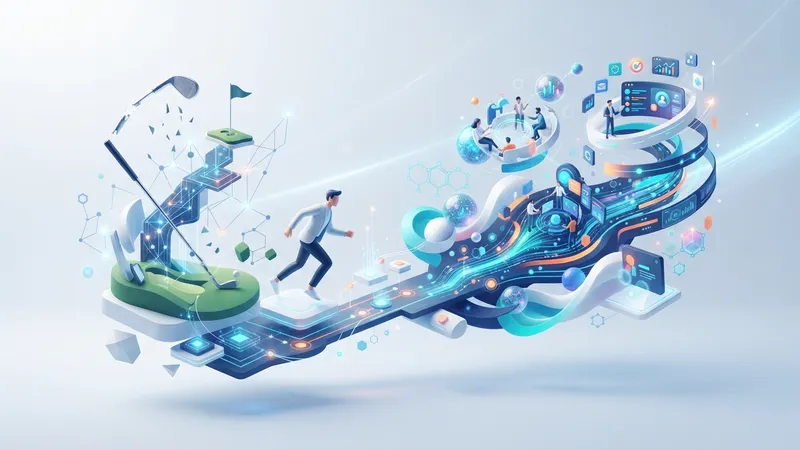
For decades, the golf course has been synonymous with deal-making and relationship-building on Wall Street. But a new generation of financial elites is breaking that tradition. According to interviews with several rising stars by Business Insider, they prefer to expand their networks through interest-based communities, digital platforms, and diverse social events rather than adhering to golf course business socializing.
These rising stars include young professionals from private equity, hedge funds, and investment banking. They say traditional golf networking is often time-consuming and high-barrier, while emerging approaches are more efficient and inclusive. For example, some meet peers through running clubs, others connect in online investment communities, and some leverage networking sessions at industry conferences to expand their networks.
One interviewee noted that colleagues from diverse backgrounds tend to choose non-traditional social settings, which helps break Wall Street's ingrained homogeneous circles. Additionally, the rise of remote work has prompted young bankers to find new ways to connect, such as through virtual coffee chats or professional community platforms to maintain relationships.
However, golf hasn't completely left the stage. Some veterans still believe the golf course is a unique place to observe character and build deep trust. But the new generation values authentic interests and shared values over deliberate business socializing. This shift is reshaping Wall Street's social culture and giving more diverse talent opportunities to enter core circles.
[AgentUpdate Depth Analysis] The evolution of Wall Street networking offers an intriguing parallel to the AI Agent ecosystem. Traditional golf socializing resembles a closed monolithic system dependent on specific settings and long-term relationships; the new generation's diverse networking is more like multi-agent collaboration, achieving efficient matching through interest tags and digital platforms. In the AI Agent space, we are witnessing a similar shift: from isolated applications of single large language models to an ecosystem network of multi-agent coordination. For instance, frameworks like LangChain and CrewAI are driving standardized communication between agents, while the MCP protocol attempts to solve the connection between agents and external tools. In the future, the "social network" of the Agent ecosystem will no longer rely on predefined fixed pipelines but will achieve adaptive collaboration through dynamic discovery and intent routing. This requires us to rethink agent identity authentication, trust establishment, and incentive mechanisms—just as Wall Street's rising stars replace deliberate socializing with genuine interests, AI Agents need to build trusted collaboration based on verifiable credentials and reputation systems. For developers, focusing on agent interoperability and decentralized identity will be key to capturing the next wave of ecosystem opportunities.