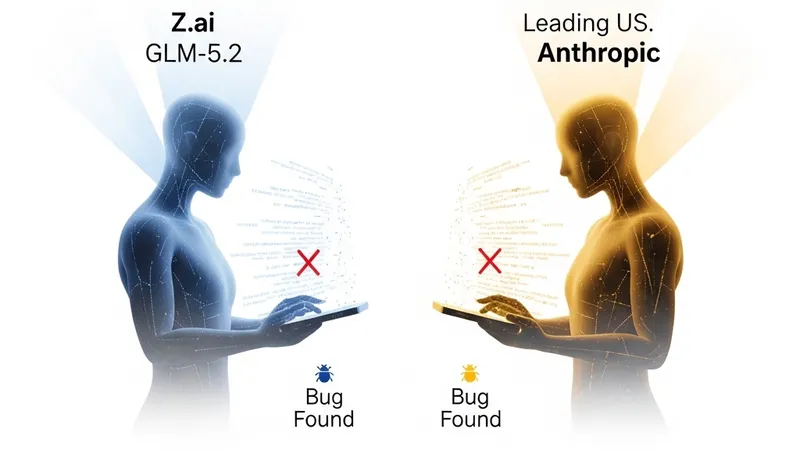
According to reports from the Wall Street Journal and other media outlets, researchers have revealed that Chinese AI pioneer Z.ai's (#Zhipu AI) newly released GLM-5.2 model matches the capabilities of top-tier U.S. models, such as Anthropic's highly anticipated systems, in detecting critical #cybersecurity bugs. This finding has raised alarms in Washington, fueling arguments that the U.S.'s lax policies on limiting Chinese open models are inadvertently handing Beijing a major advantage in cyberwarfare.
While U.S. regulators have focused heavily on restricting advanced hardware exports and limiting global access to proprietary American models, critics note that Chinese open-weight models have progressed rapidly. A recent report by Jefferies highlights that cheaper and highly capable Chinese AI models are quietly dominating the enterprise AI market globally, bypassing Western competitors on sheer cost-efficiency.
In cybersecurity benchmarking, #GLM-5.2 demonstrated robust capabilities in automated code auditing and vulnerability detection. While this offers unprecedented automation for defense teams, security experts warn it also lowers the barrier for automated zero-day exploit generation. The policy debate in Washington is intensifying, as critics push for tighter restrictions on open-source weights to prevent geopolitical adversaries from leveraging these advancements in offense-oriented cyber operations.
[AgentUpdate Depth Analysis] The success of GLM-5.2 in the highly specialized field of cybersecurity signals a pivotal shift from general linguistic LLMs to specialized, goal-oriented AI Agents. Vulnerability hunting requires deep semantic understanding, multi-step planning, and deductive reasoning—all of which are foundational traits of advanced AI Agents. GLM-5.2's performance proves that open-weight Chinese models are now viable backbones for autonomous Security Agents. In the broader Agent ecosystem, this demonstrates that open and local-deployment paradigms can successfully compete with highly restricted American cloud-hosted APIs. As autonomous agent platforms continue to mature, we expect to see an arms race between offensive and defensive Agent swarms, where the core differentiator will be local inference speed, cost efficiency, and specialized domain knowledge rather than raw model parameter size.