While AI has marked significant milestones in perfect-information games, from Deep Blue's triumph over Garry Kasparov in chess in 1997 to AlphaGo's victory against Lee Sedol in Go in 2016, one classic strategy game, #Stratego, had long remained an unconquered frontier. Even DeepMind, despite its substantial resources, struggled to build a machine capable of reliably defeating top human Stratego players.
This challenge has now been overcome. A collaborative research team from Carnegie Mellon, MIT, New York University, and Stanford University has developed an AI named Ataraxos. In a series of matches against Pim Niemeijer, widely regarded as the greatest Stratego player of all time, Ataraxos achieved a dominant record of 15 wins, 1 loss, and 4 draws. Remarkably, this feat was accomplished with a training cost of only 16 GPUs and a few thousand dollars, a testament to its efficiency.
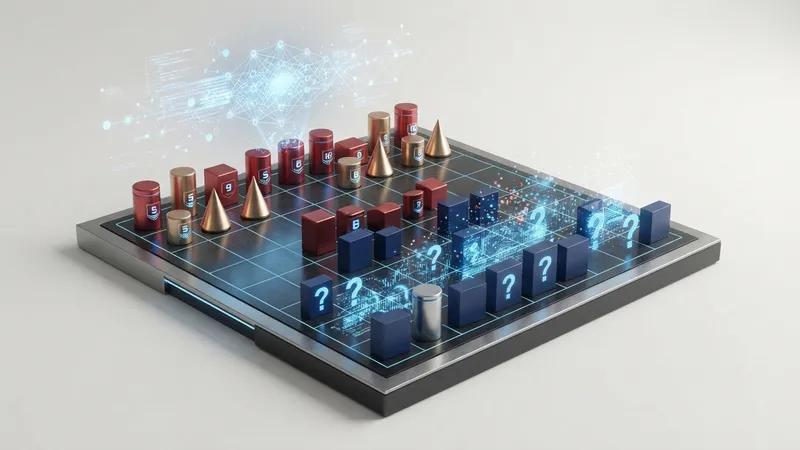
Stratego's difficulty stems from its massive amount of hidden information. Each player controls 40 pieces representing military ranks, bombs, and a flag. The objective is to capture the opponent's flag. Players know the positions of enemy pieces but not their identities, which are revealed only when pieces engage in battle. This makes Stratego an #imperfect-information game, similar to poker but significantly more complex. Gabriele Farina, an MIT computer scientist and co-author, explained that games like Texas Hold’em involve only two hidden cards, leading to a manageable 1,326 possible hands. In contrast, Stratego's 40 pieces can result in over a decillion (10^33) possible setups, making the state space astronomically vast.
Beyond the hidden information, game length poses another hurdle. Farina noted that while chess games typically last around 40 moves, a Stratego game can easily extend to 2,000 moves. Crucially, the game involves intricate bluffing mechanics; players might move a weak piece as if it were a marshal to mislead opponents. Balancing bluffing frequency to avoid predictability or meaninglessness had stumped previous AIs, including DeepMind's DeepNash, introduced in 2022. Ataraxos's success represents a significant advancement in AI's ability to handle complex imperfect-information games and long-horizon strategic planning.
[AgentUpdate Depth Analysis]
The breakthrough achieved by Ataraxos in Stratego is more than just another game AI triumph; it offers profound implications for the future of the AI Agent ecosystem. The project successfully tackles "massive hidden information" and "extremely long decision horizons"—two critical challenges for real-world AI Agents. Traditional reinforcement learning excels in perfect or limited imperfect-information settings, but struggles with the state-space explosion and credit assignment problems inherent in games like Stratego, with its 10^33 possible setups and 2000-move games. Ataraxos's ability to manage this complexity and master advanced game-theoretic strategies like bluffing suggests it integrates sophisticated techniques beyond brute-force computation, likely combining advanced Monte Carlo Tree Search (MCTS), deep neural network-based modeling of imperfect information, and belief state tracking mechanisms.
Compared to DeepMind's DeepNash, which focused on Nash equilibrium in simpler imperfect-information games like No-Limit Texas Hold'em and required immense computational resources, Ataraxos's efficient generalization and modest training footprint (only 16 GPUs) are particularly noteworthy. This suggests that advanced agent capabilities may not always demand colossal compute budgets, opening avenues for smaller research groups and startups. For AI Agents designed to operate in dynamic, highly uncertain environments, interacting strategically with humans or other AIs—such as in autonomous driving scenarios, multi-agent defense systems, financial market prediction, or intelligent supply chain management—the ability to infer intentions, plan over long horizons, and even employ deceptive tactics is paramount. Ataraxos's success provides invaluable insights and a technical roadmap for these agents to achieve "superhuman" performance in more complex, real-world strategic interactions.