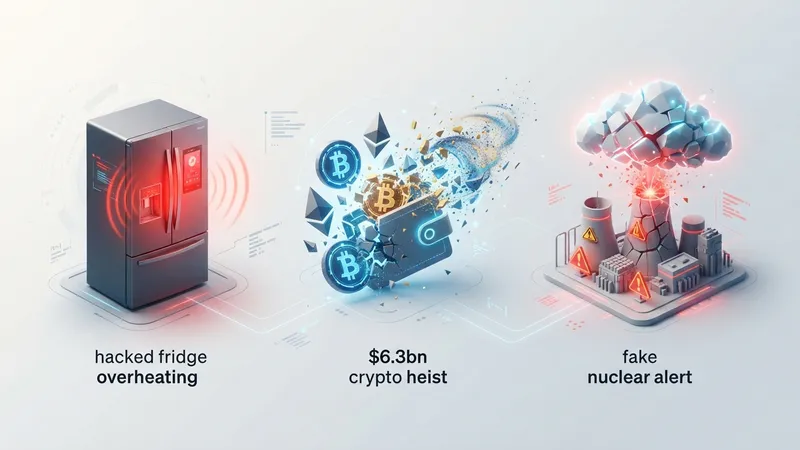
Alex Pearce was doing his morning rounds at his fruit and vegetable wholesale business in London last Monday when he noticed something odd. The defrost light on refrigeration unit 2 was on, and the panel reading was 150C. Unit 4 was the same. As he approached his biggest unit, its defrost light also blinked on. It was at this point that Pearce thought: is this a cyber-attack? He walked over to the box connecting the units to the internet and yanked out the cable. He was right.
On the same day, retailers in Belgium, Estonia, Ireland, Finland, Luxembourg, the Netherlands and Sweden reported similar problems, with refrigerators and freezers in some shops soaring to as high as 50C (122F). “If it had happened on a Saturday morning, when I don’t tend to be here, it could ultimately have led to a fire,” Pearce said.
But it is not just Pearce and a disparate group of retailers, as well as French blood banks, that have been suffering. The hacking attack was one of three over a number of days. On 30 October, the world’s largest cryptocurrency exchange, Binance, was robbed of $6.3bn (£4.7bn) in a record heist, and on 1 November hackers targeted Ukraine’s emergency alert app, sending people in Kyiv a fake nuclear strike alert.
The official message after the fridge attacks is: expect more disruption. We are in the “foothills” of a new hacking landscape, the head of the UK’s National Cyber Security Centre (NCSC) said this week. Referring to flaws in IT systems that are being exposed by AI technology, the #NCSC boss, Richard Horne, said: “There are so many vulnerabilities out there that … you could say are waiting to be exploited.” He added: “The most serious risk we face in the short term is just a huge rise in the volume of incidents … and I think you could probably point to the last few months and say we’ve started to see that.”
Websites around the world were temporarily taken out of service as a precaution last month when AI technology from the ChatGPT developer OpenAI helped discover a flaw in PHP, a computer language used to build much of the world wide web. French supermarket fridges were also attacked last month in what could have been a trial run for the more expansive foray this week.
To Azeem Azhar, a tech entrepreneur and commentator, the way AI models were discovering flaws that assailants could harness recalled China’s Covid ground zero. This was, he said, a “Wuhan moment”. Azhar’s assertion headlined a Substack post that also quoted the cybersecurity executive Matthew Prince.
[AgentUpdate Depth Analysis]These incidents mark a turning point: AI-driven cyberattacks have moved from theory to reality, characterized by cross-domain, scaled, and automated operations. Unlike traditional hacking, AI can rapidly scan and exploit vulnerabilities, even discovering unknown flaws, drastically lowering the barrier to entry. For the AI Agent ecosystem, this means security must shift from reactive to proactive defense. In the future, AI Agents must not only perform tasks but also possess self-security auditing and real-time threat awareness. Meanwhile, the proliferation of open-source models and frameworks (e.g., LangChain, AutoGPT) could exacerbate vulnerability propagation but also democratize security tools. Enterprises should build AI-based defense Agents for vulnerability prediction and automated remediation. In the long run, the #AI-security arms race will reshape Agent design paradigms, with security-left-shift and zero-trust architecture becoming standard. These events also warn that Agent autonomy must be balanced with controllability, or it could be maliciously exploited. AgentUpdate believes 2026 will be the year of AI security, and investment in security Agent R&D is urgent.