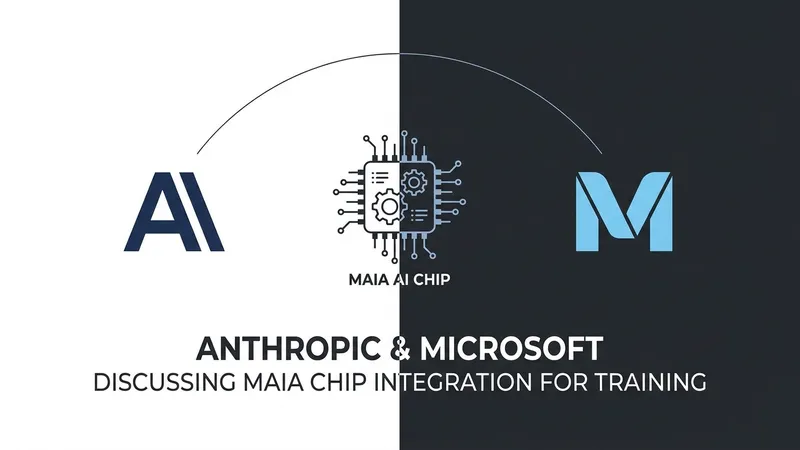
According to a report by the tech publication The Information, AI pioneer Anthropic is in active negotiations with Microsoft to utilize Microsoft’s custom-designed AI chips (such as the Maia series) to power its large language models. This potential partnership has sent ripples through the tech industry, given Anthropic’s historically tight alignment with Amazon and Google, both of whom have invested billions of dollars in the startup and positioned themselves as its primary cloud providers.
Sources familiar with the matter indicate that Anthropic is actively seeking to diversify its compute supply chain to overcome severe hardware bottlenecks associated with training and running inference for its next-generation Claude models. Microsoft has invested heavily in custom silicon, unveiling its Maia 100 chip optimized for LLMs in late 2023. Securing Anthropic as a customer for its proprietary hardware would serve as a major validation for Microsoft’s silicon strategy as it seeks to reduce dependence on Nvidia's costly GPUs.
Currently, Anthropic runs the vast majority of its workloads on Amazon Web Services (AWS) and Google Cloud. However, as model parameters scale exponentially, relying on a limited pool of cloud providers presents significant capacity risks. By integrating Microsoft’s custom silicon into its infrastructure portfolio, Anthropic can secure robust, alternative compute pipelines while potentially slashing inference costs. This move highlights a growing trend of 'compute pragmatism' among leading AI labs, who are increasingly willing to cross established cloud alliance boundaries to secure hardware.
[AgentUpdate Depth Analysis] As AI Agents transition from basic conversational interfaces to autonomous, multi-step reasoning entities, the underlying compute cost dynamics are shifting dramatically. Agentic workflows require continuous reasoning loops, tool calling, and self-correction, which exponentially increase token consumption and require ultra-low latency. Anthropic's pursuit of Microsoft’s custom chips underlines a strategic imperative: building a resilient, multi-cloud, and heterogeneous compute layer to support the scaling of agentic systems. For the broader AI Agent ecosystem, this signifies that the future of agent deployment will not rely solely on Nvidia's monopoly. Instead, it will be powered by a diversified matrix of specialized, cost-effective cloud silicon (such as Maia, Trainium, and TPUs). This transition is critical for lowering the marginal cost of agent actions, paving the way for the mass adoption of always-on, autonomous AI Agents.