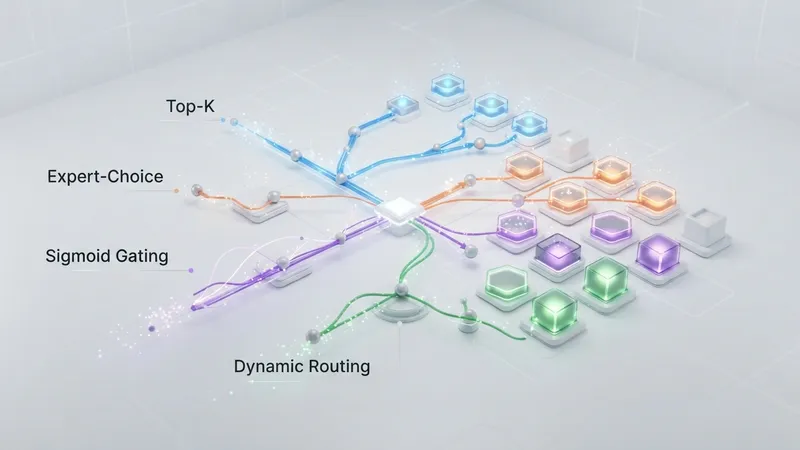
Mixture-of-Experts (MoE) architectures have become a mainstream approach for scaling large models, but the routing mechanisms vary significantly across models, directly impacting inference efficiency, training stability, and final performance. This comparison examines the #routing strategies of DeepSeek, Qwen, Mixtral, Llama 4, and gpt-oss to help developers understand their trade-offs.
DeepSeek employs fine-grained expert segmentation and shared expert designs, activating a small number of experts per token during routing, with auxiliary losses for load balancing. Its DeepSeek-V3 uses sigmoid gating instead of softmax, improving training stability. This design significantly reduces computation while maintaining high performance.
The Qwen series (e.g., Qwen1.5-MoE) uses top-k routing, selecting a fixed number of experts per token and incorporating shared experts to capture general knowledge. Its routing network is carefully initialized to avoid expert collapse. Qwen also controls per-expert load via a capacity factor, balancing efficiency and quality.
Mixtral (Mistral AI) is an early open-source MoE representative, using top-2 routing where each token activates two experts. Its routing is simple and efficient but lacks a shared expert mechanism, potentially leading to parameter redundancy. #Mixtral 8x7B activates only 13B parameters during inference, demonstrating the cost-effectiveness of MoE.
Llama 4 is rumored to adopt more advanced routing strategies, possibly combining top-k with expert choice mechanisms and optimizing load-balancing losses. Although details are undisclosed, Meta's research direction points toward dynamic routing and expert specialization to enhance multi-task performance.
gpt-oss, as OpenAI's open-source MoE model, emphasizes interpretability and stability in its routing design. It employs sigmoid-based gating and auxiliary load-balancing losses, and may introduce expert capacity limits to prevent overload. The routing strategy of gpt-oss has sparked widespread discussion in the open-source community for balancing performance and deployment cost.
Overall, the core challenge of MoE routing lies in the trade-off between load balancing and expert specialization. #DeepSeek and Qwen improve efficiency through shared experts and fine-grained designs, Mixtral wins with simple top-k, while Llama 4 and gpt-oss explore more dynamic approaches. For AI Agent developers, choosing a routing strategy requires considering task diversity, inference latency, and hardware constraints.
[AgentUpdate Depth Analysis] The differences in MoE routing mechanisms are not just technical details; they determine the underlying efficiency of the AI Agent ecosystem. DeepSeek's fine-grained shared expert design significantly reduces activated parameters, enabling agents to respond quickly in complex tasks; Qwen's top-k routing balances load through capacity factors, suitable for multi-turn dialogue scenarios. In contrast, Mixtral's simple top-2 routing is efficient but lacks shared experts, potentially leading to redundant storage of general knowledge and increasing the cognitive burden on agents. The dynamic routing explorations of Llama 4 and gpt-oss foreshadow a future where agents can adaptively select experts based on task types, achieving true "on-demand computing." In the long run, optimizing routing strategies will drive agents from single-task to multi-task collaboration, reducing deployment costs while improving inference quality. Developers should focus on the coupling between routing and agent workflows; for example, in tool-calling scenarios, the load-balancing capability of routing directly affects concurrent processing. In the future, we may see routing mechanisms combined with reinforcement learning, allowing agents to dynamically adjust expert activation patterns during operation—a key breakthrough for the AI Agent ecosystem.