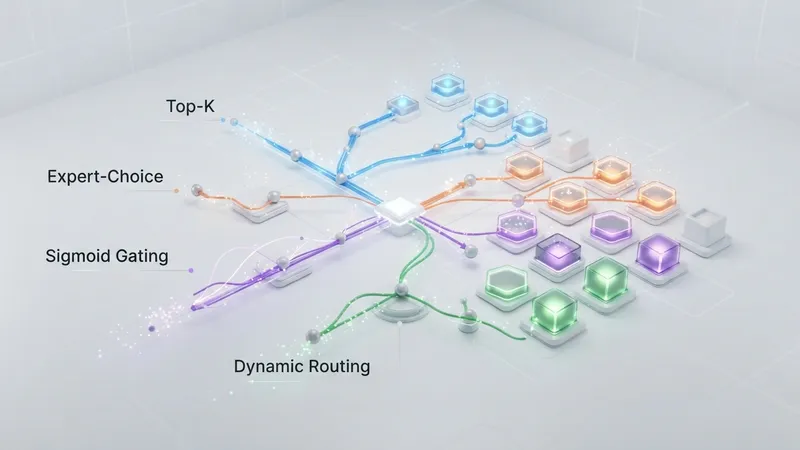
Mixture-of-Experts (#MoE) architectures have become a core paradigm for scaling modern large language models, and the #routing strategy is the key to MoE performance. This article provides an in-depth analysis of four mainstream routing approaches in 2026: Top-K routing, Expert-Choice routing, Sigmoid gating, and Dynamic routing.
Top-K routing is the classic approach: a gating network computes scores for all experts per token and activates the #top-K. It is simple and computationally efficient but prone to load imbalance—a few experts are overused while most sit idle. Notable examples include Switch Transformer with Top-1 routing and GShard with Top-2 routing.
Expert-Choice routing inverts the selection logic: experts select tokens rather than tokens selecting experts. Each expert picks the top-scoring tokens up to a capacity limit. This inherently ensures load balancing but requires additional token assignment algorithms and may sacrifice some model quality. Representative work includes Expert Choice Routing.
Sigmoid gating replaces softmax with independent sigmoid functions, where each expert independently decides whether to activate, avoiding softmax's competitive normalization. This improves routing flexibility but requires more refined auxiliary losses to prevent expert collapse. Representative models like DeepSeek-V3 use sigmoid gating with an auxiliary-loss-free load balancing strategy.
Dynamic routing adaptively adjusts routing depth or the number of experts based on input, rather than a fixed K. This can significantly improve computational efficiency but increases training complexity. A 2026 trend is combining dynamic routing with expert choice for finer-grained compute allocation.
Choosing a routing strategy requires balancing load balance, training stability, inference efficiency, and model quality. For large-scale AI Agent deployments, Sigmoid gating combined with dynamic routing is becoming the mainstream choice.
[AgentUpdate Depth Analysis] The evolution of MoE routing strategies has profound implications for the AI Agent ecosystem. The load imbalance of Top-K routing is amplified in multi-task Agent scenarios—different tasks have vastly different expert demands, and a static K is hard to adapt. Expert-Choice routing ensures balance but its token assignment algorithm may introduce extra latency in long-context Agent scenarios. Sigmoid gating's independent activation mechanism better fits the sparse activation needs of Agents, as demonstrated by DeepSeek-V3. Dynamic routing represents the future: Agent task complexity varies dynamically, and fixed routing depth is wasteful. In comparison, Mixtral's Top-2 routing suits general scenarios, while Agent scenarios need the elasticity of dynamic routing. In the future, routing strategies will be deeply coupled with Agent orchestration—the routing layer may directly perceive task type and context length, enabling predictive scheduling of expert activation. This means lower inference costs and higher task adaptability for the Agent ecosystem, but also higher requirements for training stability. In 2026, we expect more Agent-specific MoE architectures, with routing strategy becoming a key differentiator.