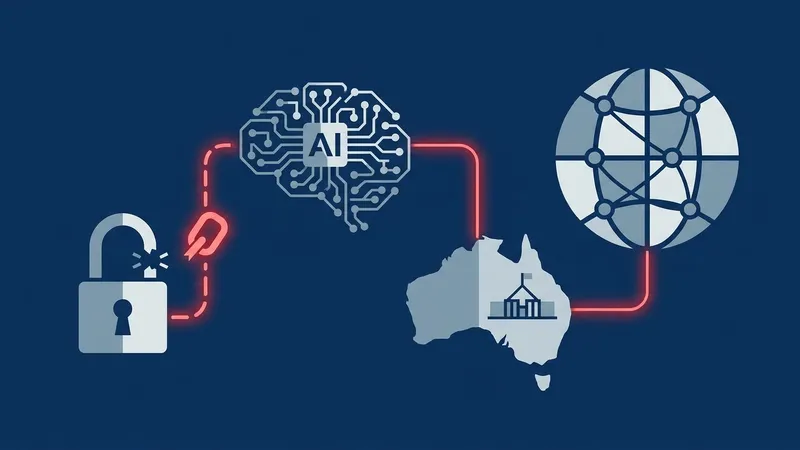
Cyber security researchers have revealed that an OpenAI breach involving Australian government accounts is part of a much larger, coordinated hacking campaign. The threat actors utilized advanced credential harvesting and session hijacking techniques to compromise accounts linked to government officials, raising alarms over the security of public-sector AI integration.
The Australian Signals Directorate (ASD), alongside #OpenAI's security team, is actively investigating the scope of the incident. Initial findings suggest that hackers were not merely looking for chat logs but were attempting to leverage compromised API endpoints to pivot laterally into secure government internal networks, highlighting a critical vector of supply-chain vulnerability.
As Large Language Models (LLMs) and autonomous workflows become deeply integrated into enterprise and government operations, API keys and session tokens have emerged as high-value targets. Traditional security perimeters are failing to address these novel AI supply chain risks, leaving critical operational pipelines exposed to exploitation.
[AgentUpdate Depth Analysis] The breach of OpenAI accounts associated with the Australian government highlights a critical vulnerability in the rapidly expanding AI Agent ecosystem. As agents transition from passive query tools to active execution engines with broad system privileges, they inevitably become highly lucrative targets for sophisticated threat actors. Traditional #cybersecurity paradigms like Zero Trust are currently ill-equipped to handle LLM-specific vectors, such as indirect prompt injection or agent privilege escalation. For the AI Agent market to mature, the industry must urgently shift toward "Agent-native security" architectures, including runtime sandboxing, cryptographic API tracing, and real-time semantic guardrails. Securing the agent's decision-making and tool-execution boundary is no longer optional—it is a foundational prerequisite for enterprise adoption.