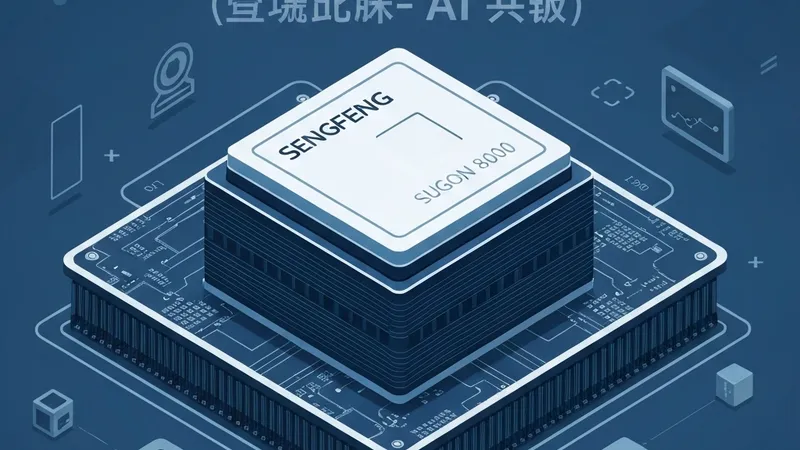
China's AI compute power has accelerated into the 100k-card era. On July 10, Sugon (Dawning Information Industry Co., Ltd.) officially announced the completion of its fully domestic AI #supercluster, Sugon 8000 (Dengfeng), in Zhengzhou. The system has been integrated into the national computing power network, bringing 100,000 domestic acceleration cards online simultaneously.
Transitioning from a 10,000-card cluster to a 100,000-card cluster is an exponential engineering leap rather than a simple scaling exercise. Issues such as network congestion, storage bottlenecks, megawatt-level heat dissipation, and scheduling complexity multiply exponentially. Instead of merely stacking GPUs, Sugon 8000 addresses these challenges through system-level innovation.
To solve the common dilemma where supercomputing centers cannot train LLMs and intelligent computing centers cannot support scientific research, Sugon 8000 implements "native supercomputing-intelligence integration". A single system can handle both FP64 double-precision scientific workloads and万亿 (trillion-parameter) LLM training with INT8 precision. By pooling heterogeneous resources, it enables unified cross-platform scheduling and improves resource utilization.
The system features a fully domestic, self-developed stack. The hardware foundation relies on Hygon chips, coupled with the scaleFabric proprietary IB-like RDMA high-speed network. Storage is handled by ParaStor distributed storage, which ranked first on both major performance charts in the 2026 IO500 global ranking. High-density liquid cooling technology is also deployed to support megawatt-level workloads efficiently.
Sugon 8000 is already accessible via the National Supercomputing Internet, adapting over 300 applications across 20+ fields. In real-world scenarios, 80,000 cards simulated protein folding, 88,000 cards achieved a 328-trillion-grid turbulence simulation, and 90,000 cards completed DFT simulations for 3.16 trillion atoms. Its open architecture supports multi-brand accelerator cards and mainstream software ecosystems, ensuring seamless toolchain migration.
[AgentUpdate Depth Analysis] As AI Agents transition from single-step tasks to complex, multi-modal autonomous planning and swarm intelligence, their underlying computational demands are undergoing a radical shift. Traditional GPU clusters often struggle with communication latency and memory bottlenecks when coordinating vast Agent networks. The "native supercomputing-intelligence integration" pioneered by Sugon 8000 offers a vital paradigm. It unifies high-precision physics simulation (FP64) and fast LLM inference (INT8), which is indispensable for future embodied AI and "physics-informed" Agents. By enabling low-latency state synchronization and cross-architecture resource pooling, such 100k-card clusters provide the perfect sandbox for training massive Agent societies. Ultimately, this milestone ensures that China's AI Agent ecosystem can thrive on fully sovereign, high-efficiency infrastructure without foreign dependency.