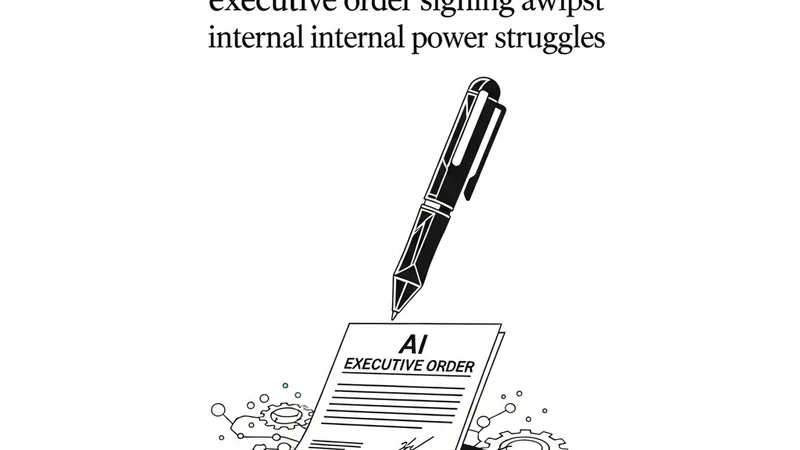
According to sources familiar with the matter, US President Donald Trump has abruptly postponed a highly anticipated executive order on artificial intelligence. The sudden delay is the direct result of intense infighting among White House advisors and key external influencers over the final language of the directive.
The executive order was initially drafted to fulfill Trump's campaign promise to repeal the Biden administration's landmark AI safety regulations, shifting toward a highly deregulatory framework. However, drafting hit a major roadblock as two powerful factions clashed in a fierce ideological battle. On one side are the tech-accelerationists, heavily backed by Silicon Valley allies like Elon Musk and venture capitalist Marc Andreessen, who advocate for open-source AI models and minimal government intervention to accelerate the path to Artificial General Intelligence (AGI). On the opposite side are national security hawks and conservative traditionalists who warn that unregulated open-source AI could leak critical capabilities to foreign adversaries, presenting severe national security risks.
Specific points of contention include whether to enforce strict export controls on advanced frontier models, how to monitor massive computing clusters, and the extent of oversight required for foundational models. Given the gridlock and the immense lobbying power of both camps, the White House opted to pull back the draft for further negotiation.
[AgentUpdate Depth Analysis] This abrupt delay in the US AI Executive Order is not merely a bureaucratic stall; it represents a critical turning point for the global AI Agent ecosystem. Over the past year, AI Agents have transitioned from simple chat interfaces to autonomous entities powered by high-capacity open-source LLMs. If the national security faction succeeds in placing strict guardrails or compliance audits on open-source weights, it could severely throttle the grassroots developer community and fragment the decentralized agent ecosystem (such as MCP and LangChain integrations). Conversely, an unbridled deregulation victory would spark massive, low-barrier agent deployments but would also thrust the burden of mitigating malicious agent behavior—such as autonomous cyberattacks or automated disinformation—entirely onto the open-source community. The resolution of this White House debate will fundamentally determine whether the next phase of AI Agent evolution leans toward high-risk hyper-acceleration or standardized, compliance-driven growth.