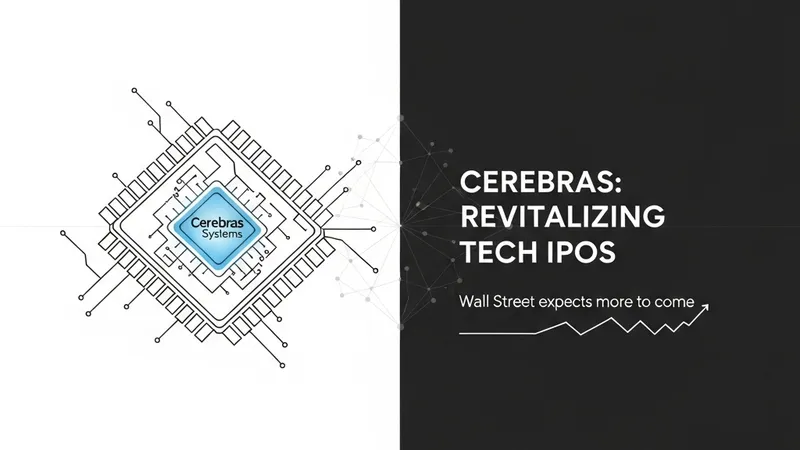
As one of the most formidable challengers to Nvidia in the AI #hardware space, silicon unicorn #Cerebras Systems is officially marching toward its Nasdaq debut. This landmark IPO has not only sent shockwaves through Silicon Valley but has also reignited Wall Street's long-dormant enthusiasm for tech listings. Against the backdrop of the Federal Reserve's rate-cut cycle and insatiable market appetite for AI infrastructure, investment bankers expect Cerebras' debut to serve as a crucial icebreaker for the tech IPO market after a two-year drought.
Cerebras has earned its reputation through its signature Wafer-Scale Engine (WSE). Unlike traditional chipmaking, which carves a wafer into hundreds of individual GPUs, Cerebras crafts a single, massive processor out of an entire silicon wafer. Its latest-generation WSE-3 processor boasts an astronomical 4 trillion transistors and 900,000 AI-optimized cores. In real-world benchmarks, Cerebras' single-chip system delivers throughput and ultra-low latency that far surpass traditional GPU clusters for large language model (LLM) #inference, positioning it as a highly compelling alternative to Nvidia's H100 and B200 platforms.
Financial filings reveal explosive revenue growth for Cerebras. Although its balance sheet currently shows high concentration from key customers like UAE-based AI conglomerate G42, its absolute advantages in inference speed and cost-performance have attracted cloud providers and enterprises eager to bypass Nvidia's supply-chain monopoly. Wall Street analysts point out that the massive institutional demand for Cerebras reflects a strategic defensive play by buy-side investors seeking alternative compute. Consequently, a flock of AI infrastructure scale-ups, including CoreWeave and Groq, are now accelerating their public listing timelines.
[AgentUpdate Depth Analysis] From the perspective of the AI Agent ecosystem, Cerebras’ market debut represents a critical inflection point. Currently, the bottleneck of scaling autonomous agents lies in high inference costs and latency. Cerebras’ wafer-scale technology is optimized specifically for low-latency, high-throughput memory access, making it exceptionally well-suited for fast-token generation required by agentic workflows. As public capital scales up these alternative compute architectures, the cost barrier for complex, multi-step agent reasoning will drop significantly. This paradigm shift will accelerate the transition of AI Agents from slow, single-turn assistants to real-time, highly collaborative, and deeply autonomous entities, reshaping the future of enterprise automation.